This is Part 1 of our three-part series: Automating Your Twitch Content. Part 2: Setting Up Automated Distribution | Part 3: Optimising for Maximum Reach
You didn't start streaming to become a full-time social media manager. You started because you love gaming, you love the community, and you wanted to build something real. But somewhere between going live and growing your channel, a second job crept in. One that nobody warned you about. And it's quietly strangling your growth.
This isn't another "here are 8 social media tips" article. This is a data-backed look at what manual content distribution is actually costing you, why it leads to burnout, and why that burnout is the single biggest threat to your channel's future. If you've ever felt like you're spending more time promoting your stream than actually streaming, you're not imagining it. The numbers prove it.
The Off-Stream Grind Nobody Talks About
Let's walk through what content distribution actually looks like for a streamer doing it manually. You finish a four-hour stream. You're tired, maybe buzzing from a great session, maybe drained from a rough one. But the work isn't over. Now you need to:
- Review your VOD and identify the best moments
- Clip those highlights (or hope your viewers clipped something decent)
- Edit each clip for length, pacing, and context
- Resize and reformat for each platform (9:16 for TikTok and Shorts, 4:5 for Instagram, 16:9 for X)
- Write captions tailored to each platform's tone and character limits
- Add hashtags, tags, and descriptions
- Upload individually to TikTok, YouTube Shorts, Instagram Reels, X, and wherever else
- Respond to comments across all those platforms
- Do it all again before your next stream
That's not a quick task. That's an entire workflow, and it multiplies with every platform you're trying to maintain. According to streamer testimonials compiled on Quora, full-time streamers report spending 35 to 40 hours per week on social media content creation, compared to roughly 20 hours actually streaming. Read that again. The off-stream grind is nearly double the time spent on-stream.
Even if you're not full-time, the numbers are stark. A VerticalResponse survey found that 43% of small creators and business owners spend six or more hours per week just on social media management. For streamers juggling a day job, that's your entire evening, multiple nights a week, gone. Not to creating content. Not to streaming. To distributing content you've already created.
If you've ever felt like you're running on a treadmill that keeps speeding up, this is why. The content creation itself isn't the bottleneck. The clipping and distribution pipeline is. And it's eating your time, your energy, and eventually your motivation to stream.
The Burnout Numbers Are Brutal
Let's stop treating burnout like a vague feeling and look at what the research actually says. The data is worse than most streamers realise.
90% of Creators Have Experienced Burnout
According to the Vibely Creator Burnout Report, a staggering 90% of content creators have experienced burnout, and 71% have seriously considered quitting entirely. These aren't hobbyists casually posting once a week. This survey covered creators with established audiences, people who've built real communities and still found themselves hitting a wall.
The Awin Group's 2024 Creator Survey reinforced this, finding that 79% of creators have experienced burnout. That figure climbed to 83% for creators who've monetised their content. So the more seriously you take your channel, the more likely you are to burn out. That's not a wellness issue. That's a structural problem.
The Specific Causes Streamers Face
The Harvard T.H. Chan School of Public Health, in partnership with Creators 4 Mental Health, surveyed over 500 creators and found that 65% experience anxiety or depression related to their work. Only 8% described their mental health as excellent, and that number dropped to just 4% for creators who'd been at it for five years or more.
The causes won't surprise you if you've lived them. The Vibely report found that 65% of creators cited algorithm changes as a top stressor, while 51% pointed to "constantly having to come up with new ideas and post to new platforms." It's not the streaming that burns people out. It's everything around the streaming.
Why Streamers Are Uniquely Vulnerable
Here's what makes streamers different from other creators. A YouTuber creates a video, uploads it, and can step away. A podcaster records, edits, publishes, done. But streamers are performing live (with all the energy and emotional labour that demands), then expected to turn around and execute an entire post-production and distribution workflow on top of it.
You're simultaneously a live performer, a video editor, a social media manager, a community moderator, and (if you're trying to grow) a marketing strategist. That's five roles. Most companies have separate teams for each one. You're doing all of them, probably from the same chair, often with ADHD or other neurodivergent traits that make repetitive admin tasks feel like wading through treacle.
The streaming community skews heavily neurodivergent. The executive function demands of manually managing content across five or six platforms, remembering different character limits, aspect ratios, hashtag strategies, and posting schedules, that's not just tedious. For many streamers, it's genuinely paralysing. And when a task feels impossible, it doesn't get done. Which brings us to the real cost of all this.
Why Inconsistency Is the Real Growth Killer
Burnout doesn't just affect how you feel. It directly impacts your growth through a mechanism that's brutally simple: burnout causes inconsistency, and inconsistency tanks your reach.
The Inconsistency Tax (5x Engagement Penalty)
A Buffer study analysing over 100,000 accounts across six months found that consistent posters (those who posted for 20 or more weeks out of 26) received five times more engagement per post than inconsistent posters. Even moderately consistent creators got four times more. This isn't a marginal difference. It's a fivefold gap.
Think about what that means. Two streamers with identical content quality, identical personality, identical games. One posts consistently across social media. The other posts in bursts and then goes quiet. The consistent streamer gets five times more engagement on every single post. Over weeks and months, that compounds into a massive difference in discoverability, follower growth, and ultimately, viewer count.
Additional Buffer research analysing 52 million posts found that accounts posting 10 or more times per week averaged 32 additional followers per week compared to weeks when they posted nothing. The critical finding? Any posting is substantially better than no posting. The bar isn't perfection. It's presence.
And here's the kicker for streamers specifically: research from AMW Group found that channels actively engaging with their audience through comments, polls, and community posts saw 189% higher subscriber retention rates. Consistency isn't just about posting. It's about staying visible and present in your community's feed, even when you're not live.
The Vicious Cycle: Burnout, Breaks, Lost Growth, Deeper Burnout
Here's where it gets really painful. The cycle works like this:
- You stream and try to maintain social media across multiple platforms manually.
- The workload becomes unsustainable. You start cutting corners or skipping platforms.
- You burn out and take a break from social media (or streaming entirely).
- During your break, the algorithm forgets you exist. Your engagement drops. Followers drift away.
- You come back to lower numbers, less momentum, and the demoralising feeling that you've lost weeks of progress.
- The pressure to "catch up" makes the next burnout come even faster.
This isn't a personal failure. It's a systems failure. You're trying to run a manual process that doesn't scale, and when it inevitably breaks down, you lose more ground than you gained. The advice to "just post more" or "just be consistent" is about as helpful as telling someone with a broken leg to "just walk it off." The problem isn't effort or willpower. The problem is that the workflow itself is broken.
If you're stuck in this cycle, you're not alone. We've written an entire guide on how to get more viewers on Twitch without burning out that goes deeper into sustainable growth strategies.
The Short-Form Video Opportunity You're Sitting On
While you're drowning in manual distribution, the biggest content opportunity in a generation is passing you by. Short-form video isn't just growing. It's dominating everything.
Industry data for 2026 shows that YouTube Shorts alone now generates over 200 billion views per day, up from 70 billion in early 2024. Short-form video accounts for 82% of all global internet traffic. TikTok, Instagram Reels, and YouTube Shorts aren't niche platforms anymore. They're where the majority of internet consumption happens.
And here's what makes this so frustrating for streamers: you already have the raw material. Every stream you do produces hours of potential content. Funny moments, clutch plays, wholesome interactions, rage-worthy fails, insightful commentary. It's all there in your VODs. The content exists. What doesn't exist is the distribution pipeline.
Most streamers are sitting on a goldmine of clips and doing nothing with them, not because they don't want to, but because the manual work of turning a four-hour stream into a dozen platform-optimised short-form videos is simply too much. That gap between raw material and distributed content is where your growth is leaking. Every stream that goes unclipped and unshared is a missed opportunity to reach people who've never heard of you but would absolutely love your content.
The streamers who are growing fastest right now aren't necessarily the most talented or the most entertaining. They're the ones who've figured out how to get their content in front of new eyeballs consistently. And in 2026, that means short-form video, distributed across every major platform, posted consistently.
What "Automation" Actually Means for Streamers
The word "automation" makes some streamers uncomfortable. So let's clear the air before we go any further.
It's Not Bots or Fake Engagement
When we talk about automated content distribution for streamers, we're not talking about bots that spam comments, fake followers, or AI-generated personalities pretending to be you. We're not talking about anything that violates platform terms of service or feels inauthentic to your community.
We're talking about automating the tedious, repetitive, soul-crushing admin work that sits between "I had a great stream" and "people actually see my best moments." The clipping, the reformatting, the captioning, the uploading, the scheduling. The stuff that takes hours but adds zero creative value. Your content stays yours. Your voice stays yours. Your community stays yours. The only thing that changes is that a machine handles the boring bits instead of you.
The Real Workflow: Stream Once, Distribute Everywhere
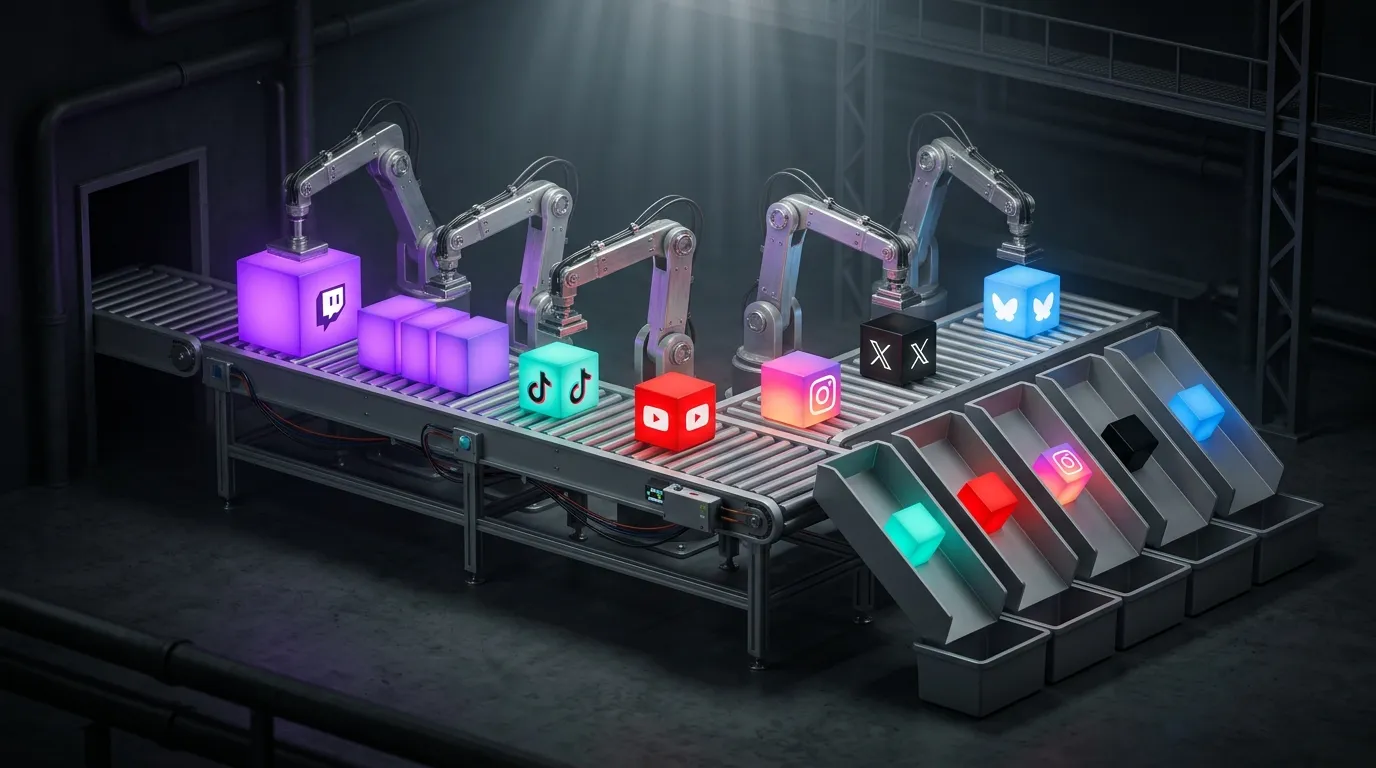
Here's what an automated content pipeline looks like in practice:
- You stream. That's it. That's your creative contribution.
- AI identifies your best moments from the stream, picking out highlights, funny clips, and engaging segments.
- Those clips are automatically edited for length and pacing, with captions added.
- Each clip is reformatted for every platform: vertical for TikTok and Shorts, square or landscape for X and others.
- Platform-specific captions and hashtags are generated based on what works on each platform.
- Everything is posted on a schedule optimised for when your audience is most active across each platform.
The entire pipeline from stream to multi-platform distribution happens without you manually touching each clip, each platform, each upload. You stream once. Your content appears everywhere. That's what tools like Streamer Share are built to do: handle the distribution so you can focus on what actually matters, creating great content and connecting with your community.
The Time You Get Back
According to research compiled by SocialBu, 74% of marketers report significant time savings with automation. Teams using automated distribution tools report reclaiming up to 15 hours per week that was previously spent on manual publishing.
For a streamer, 15 hours a week is transformative. That's time you could spend actually streaming more, engaging with your community on Discord, resting so you don't burn out, learning new games, or just living your life. The entire point of automation isn't to remove the human element. It's to give you back the hours that manual distribution was stealing from you.
And remember the consistency data from earlier? Consistent posting earns you five times more engagement. Automation makes consistency effortless. You don't need to remember to post. You don't need to carve out hours for editing. You don't need to fight through executive dysfunction to manually upload to five platforms. The system handles it, and your growth benefits from the kind of rock-solid consistency that manual workflows simply can't sustain.
In Part 2 of this series, we'll walk through exactly how to set up an automated distribution pipeline step by step, so you can see what this looks like in practice. And in Part 3, we'll cover how to optimise your automated content for maximum reach across every platform.
Key Takeaways
- The off-stream grind is real. Full-time streamers report spending nearly double the hours on social media content as they do actually streaming. Even part-time creators lose 6+ hours a week to manual distribution.
- Burnout isn't a personal failure. 90% of creators experience it. 65% deal with anxiety or depression from their work. The causes are structural, not individual.
- Inconsistency is the growth killer. Consistent posters earn 5x more engagement. Every break you take resets your momentum and makes the algorithm forget you.
- You already have the content. Short-form video dominates the internet with 200B+ daily views on YouTube Shorts alone. Your streams are full of clip-worthy moments that never get distributed.
- Automation solves the distribution problem. It's not about bots or fake engagement. It's about removing the manual admin work so you can stream, let the system distribute, and stay consistent without burning out.
- The fix isn't "try harder." It's building a system. Explore how Streamer Share works or jump to Part 2 to start setting one up.
Frequently Asked Questions
How often should streamers post on social media?
Research shows that posting 10 or more times per week across platforms delivers the strongest growth, averaging 32 additional followers per week compared to silent periods. However, the most important factor isn't hitting a specific number. It's consistency over time. Buffer's study found that creators who posted consistently for 20+ weeks earned five times more engagement than those who posted in bursts. Aim for a sustainable frequency you can maintain every week, even if that starts at just a few posts. Consistent presence matters more than high volume.
How many hours do streamers spend on social media?
Full-time streamers report spending 35 to 40 hours per week on social media content creation and distribution, which is nearly double the 20 hours they spend actually streaming. Even part-time or smaller creators typically spend six or more hours per week on social media management alone. This off-stream workload includes clipping highlights, editing for different formats, writing platform-specific captions, uploading, and engaging with comments across multiple platforms.
What's the best social media platform for Twitch streamers?
There isn't a single "best" platform; the strongest strategy is distributing your content across multiple short-form video platforms simultaneously. YouTube Shorts generates over 200 billion daily views and is currently the highest-reach platform for discoverability. TikTok remains excellent for viral growth and reaching younger audiences. Instagram Reels works well for building a more personal brand. X (formerly Twitter) is strong for community interaction and real-time engagement. The real advantage comes from being present on all of them consistently, which is where automated distribution tools become essential.
Can you automate social media for streaming?
Yes. Modern automation tools designed for streamers can handle the entire pipeline from stream to social media post. This includes AI-powered clip detection from your VODs, automatic editing and reformatting for each platform's specifications, caption and hashtag generation, and scheduled posting across TikTok, YouTube Shorts, Instagram Reels, and more. This isn't about fake engagement or bot activity. It's about removing the repetitive manual work of distribution so your authentic content reaches more people. Platforms like Streamer Share are built specifically for this workflow.
How do you avoid streamer burnout?
The biggest cause of streamer burnout isn't streaming itself; it's the off-stream workload of content creation and distribution across multiple platforms. To avoid burnout: first, automate your content distribution so you're not manually clipping, editing, and uploading for hours after every stream. Second, set realistic streaming schedules you can sustain long-term rather than pushing for maximum hours. Third, take genuine breaks without guilt (your mental health matters more than any algorithm). Fourth, build systems that keep your content flowing even when you step back. The goal is to make consistency sustainable rather than relying on willpower alone. For more on this, read our guide on growing on Twitch without burning out.
This is Part 1 of our three-part series: Automating Your Twitch Content. Continue to Part 2: Setting Up Automated Distribution or jump ahead to Part 3: Optimising for Maximum Reach.